Akan Gold Weights: Tiny Brass Sculptures That Spoke in Proverbs
For centuries, the Akan of Ghana and Côte d'Ivoire weighed gold dust with small brass figures of people, animals and symbols. Many carry proverbs. Here is their story.
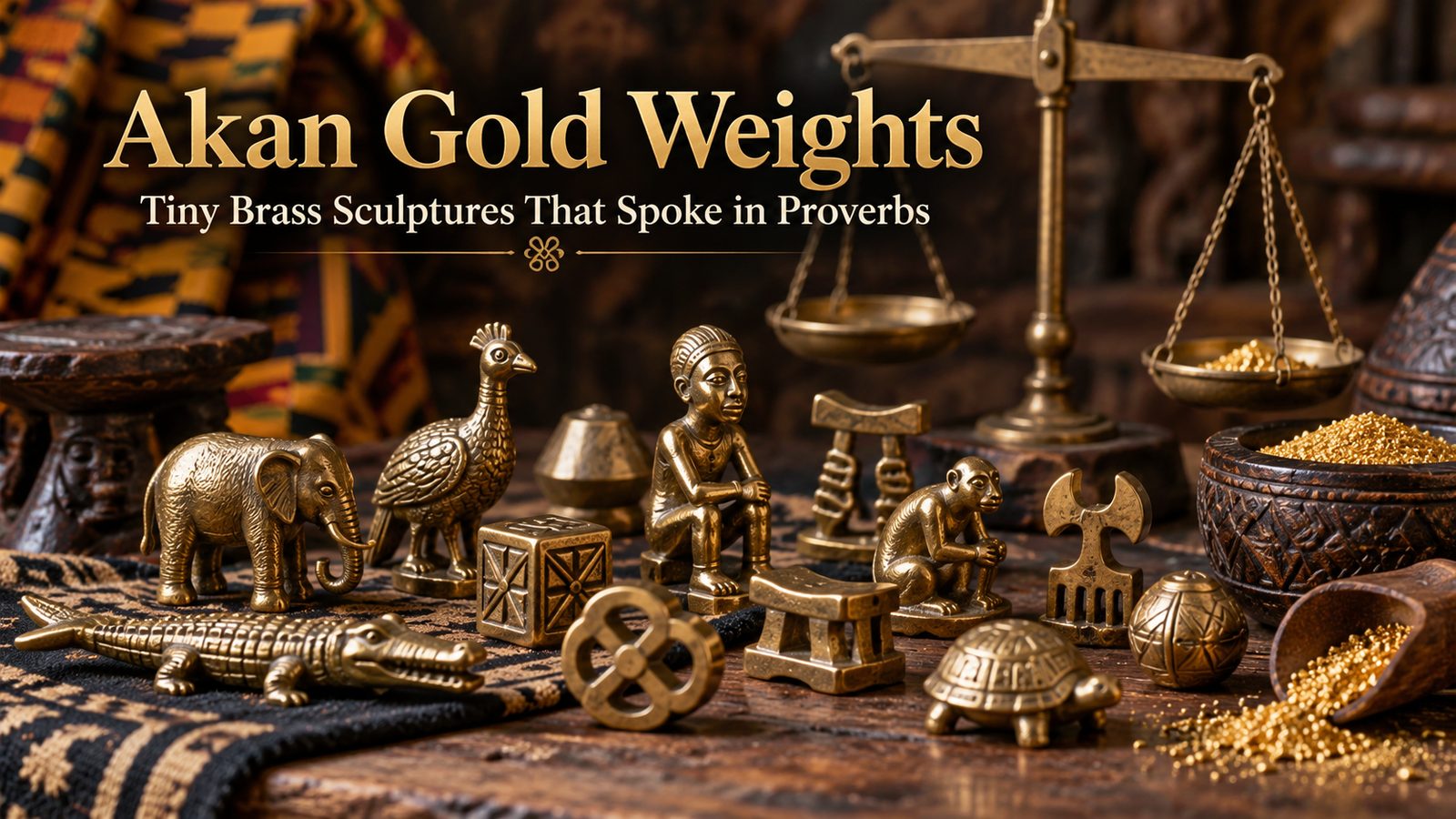
Hold one in your hand and it is barely the size of your thumb: a little brass figure of a man playing a drum, two crocodiles sharing one stomach, a bird looking backward, a porcupine bristling with quills. Some are simple geometric shapes; others are tiny, detailed scenes. For hundreds of years, these miniature sculptures had a very practical job. They were weights — used by the Akan peoples of present-day Ghana and Côte d'Ivoire to weigh gold dust, the currency of their world.
A land of gold
The forests of the Akan region were among the richest sources of gold in Africa. From around the 14th or 15th century, gold from the Akan goldfields travelled north across the Sahara and, from the 15th century, south to European traders on the coast — which is why the Europeans called the region the Gold Coast.
Within Akan states, including the powerful Asante kingdom, gold dust served as money. People carried it in small pouches and paid for everything from market goods to taxes and fines by weighing out the right amount.
How the weights worked
To weigh gold dust, traders used:
- A small balance scale, with two hanging pans.
- A set of weights (mrammuo), kept in a cloth or leather bag along with tiny spoons, sieves, boxes and a small brush to sweep gold dust.
A buyer and seller each typically had their own set, and the weights were based on standard units adapted from those used in the trans-Saharan and Islamic trade, and later from Portuguese and other European units. Weighing gold was a serious matter, and skill and honesty were essential.
Made by lost-wax casting
Akan gold weights were made of brass, using the lost-wax method:
- A model was shaped in beeswax.
- It was covered in clay, leaving a small channel.
- The mould was heated; the wax melted out, leaving a hollow.
- Molten brass was poured in.
- The mould was broken to reveal the brass weight.
Each piece was unique. Some figurative weights were even cast directly from real objects — a beetle, a seed, a peanut — by covering them in clay and burning them out.
Geometric and figurative
There are two broad types:
- Geometric weights — the older type, with abstract designs: squares, crosses, spirals, ladders and patterns, some related to adinkra symbols.
- Figurative weights — later and more famous, showing people, animals, plants and objects: warriors, drummers, chiefs on stools, fish, birds, crocodiles, scorpions, antelopes, swords, sandals and more.
Proverbs in brass
Many figurative weights illustrate proverbs. A weight placed on the scale could make a point in a negotiation, without a word being said. Some examples often cited:
- Two crocodiles sharing one stomach — they share one stomach yet fight over food; a lesson about unity and shared interests.
- A bird looking backward — the Sankofa idea: go back and fetch what you have forgotten.
- A porcupine — a symbol of the Asante army: "kill a thousand, a thousand more will come."
- A man climbing a tree — "when you climb a good tree, people will help push you up."
The end of an era — and a new life
In the early 20th century, the British colonial government introduced coins and banknotes, and gold dust stopped being used as money. Gold weights were no longer needed for everyday trade. Many were sold, collected, or melted down, and large numbers ended up in museums in Europe and North America.
Today they are prized as one of Africa's great miniature art forms, and contemporary Ghanaian craftsmen still cast brass figures using the old techniques.
Why it matters
Akan gold weights show how art and everyday life were intertwined: a tool for weighing money could also be a sculpture and a proverb. They are small enough to fit in a pocket, yet they hold the story of a great gold-trading civilisation and its wisdom.
Further reading
- British Museum — Akan goldweights collection
- Timothy F. Garrard, Akan Weights and the Gold Trade (Longman, 1980)
- Tom Phillips (ed.), Africa: The Art of a Continent (Prestel, 1995)

