Adire: The Indigo Cloth of the Yoruba Women of Abeokuta
Patterns tied, stitched or painted on with cassava paste, then dyed deep blue in indigo: adire is the resist-dyed cloth of the Yoruba, a craft led by women for generations.
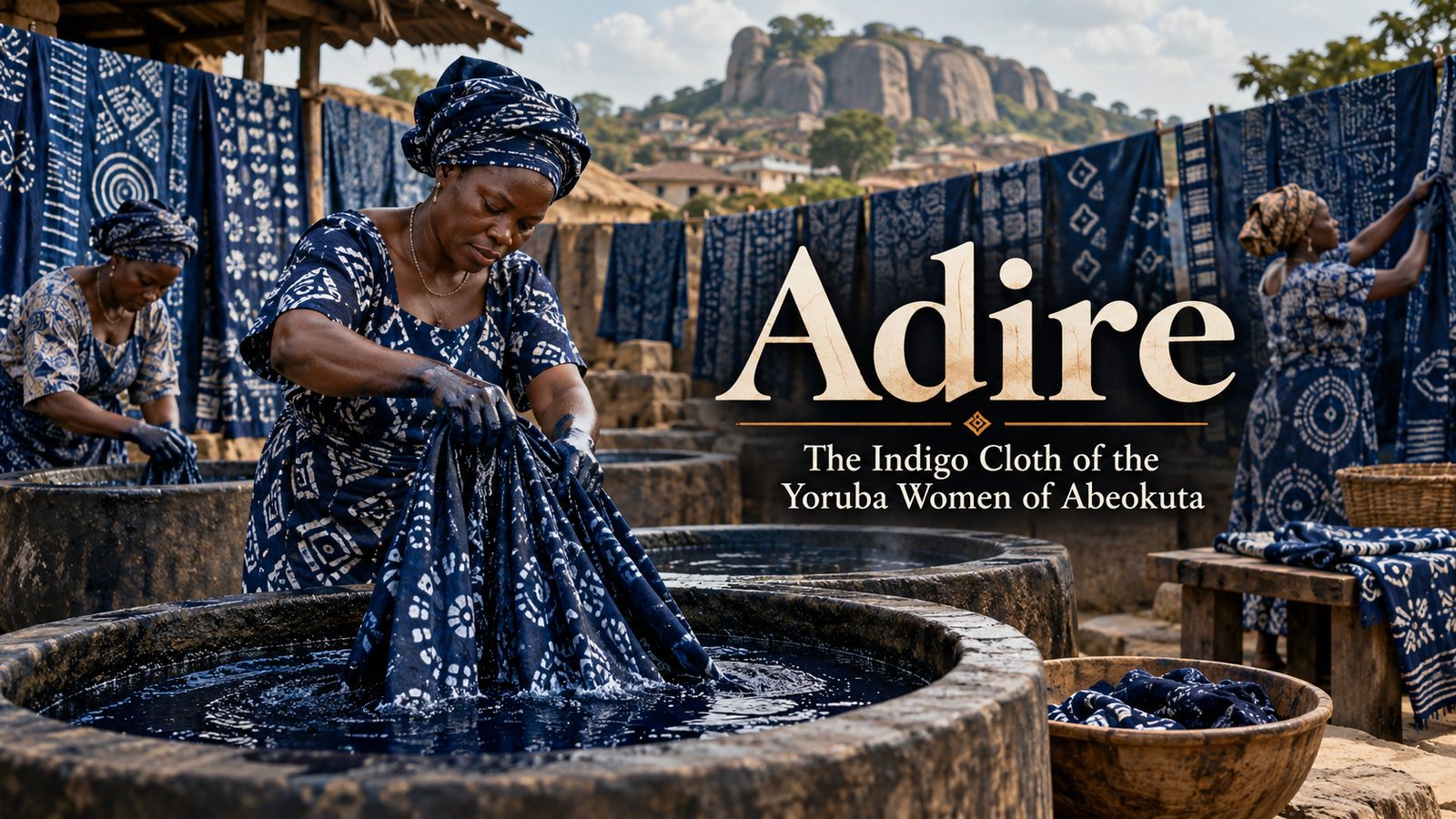
Picture a market in Abeokuta, in southwestern Nigeria. Lengths of cloth hang everywhere, in every shade of indigo blue — from pale sky to a blue so deep it looks almost black. Each one is covered with patterns in lighter blue or white: circles, spirals, stripes, flowers, birds, even words and dates. The cloth is called adire, and it is one of the great textile traditions of the Yoruba people.
What adire means
In Yoruba, adire roughly means "tie and dye" (adi — to tie, re — to dye). It refers to cloth decorated using resist-dyeing: parts of the fabric are protected so that the dye cannot reach them, leaving patterns when the cloth is dyed.
The traditional dye is indigo, made from the leaves of local plants (in Yoruba, elu). The leaves were pounded, formed into balls, dried, and fermented in large pots with ash water to make a dye bath. Dyeing could be repeated many times to achieve deeper and deeper blues.
Techniques
Adire makers use several methods to create patterns:
- Adire oniko (tie) — small bits of cloth are tied tightly with raffia thread, sometimes around seeds or stones, creating circles and dots when dyed.
- Adire alabere (stitch) — patterns are stitched into the cloth with raffia and pulled tight, then the stitches are removed after dyeing to reveal fine lines.
- Adire eleko (paste) — a thick paste made from cassava starch is applied to the cloth, either painted on freehand with a feather or palm rib, or pressed through metal stencils. The paste blocks the dye, leaving a pale pattern.
Freehand eleko painting was especially admired. Skilled women painted complex designs covering entire cloths, and famous patterns have names. One of the best known, Ibadandun ("Ibadan is sweet"), shows pillars inspired by the city hall in Ibadan; another, Olokun, is dedicated to the goddess of the sea.
A women's industry
Adire production was historically dominated by women. In Abeokuta and Ibadan in the early 20th century, women dyers built a thriving industry, organised in compounds and guilds. Imported factory-made white cotton cloth from Britain made production cheaper, and adire boomed, sold across West Africa.
The industry faced crises — competition from cheap imported prints and synthetic dyes, and economic downturns. Historians have documented how women dyers in Abeokuta resisted colonial attempts to regulate and tax their trade, defending their livelihoods.
Adire today
Abeokuta remains the heart of adire, especially at the Itoku market, where dyers still work with indigo and, increasingly, synthetic dyes in many colours. Adire has enjoyed a strong revival as fashion: Nigerian designers use it for dresses, shirts, jackets and accessories, and it is worn proudly at events and celebrations. Workshops teach visitors to make their own.
Adire belongs to a family of West African resist-dyed textiles, related to the mud-painted bògòlanfini of Mali, and to the indigo cloths of Mali, Senegal and the Sahel — each with its own techniques and meanings. Like the raffia velvets of the Congo described in our story on Kuba cloth, adire shows how much artistry can go into a single length of fabric.
Why it matters
Adire is the story of women's skill, creativity and enterprise — of patterns painted by hand with cassava paste, of indigo pots tended for weeks, and of an industry built and defended by women. Wear a piece of adire, and you are wearing Yoruba history in blue.
Further reading
- Jane Barbour and Doig Simmonds (eds.), Adire Cloth in Nigeria (Institute of African Studies, University of Ibadan, 1971)
- British Museum — Adire cloth collection
- Judith Byfield, The Bluest Hands: A Social and Economic History of Women Dyers in Abeokuta (Nigeria), 1890–1940 (Heinemann, 2002)

